



On September 21, on the eve of the 2026 Apsara Conference, acclaimed director and screenwriter Lu Chuan took the stage with the trailer for his AIGC short film, The Site of History. It is the first time he has used AI to create film-grade imagery in depth, and it marks a "human–AI co-creation" with Alibaba's video-generation model.
By the math of traditional film production, reconstructing the Ming-dynasty Beijing cityscape, the imperial palace, and a massive explosion would start with months of time and a budget in the tens of millions—even just filming a live explosion sequence once took 19 days. This time, from historical research to image generation, the team needed only five days.
That contrast is what the whole industry is now paying attention to.
Using AI to "Return to the Scene" of a 400-Year-Old Mystery
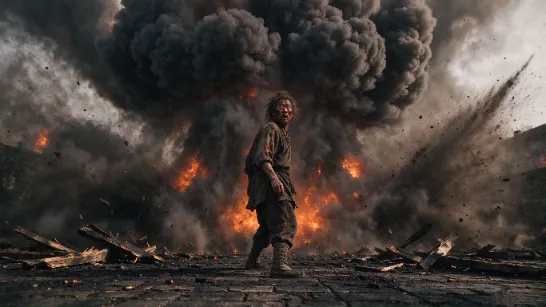
The Site of History depicts the 1626 "Wanggongchang Incident" of the Ming dynasty—a massive explosion at the Wanggongchang gunpowder arsenal in the southwest of Beijing whose cause remains a mystery to this day. Precisely because it is "unsolved," it offers both a vast canvas and a formidable challenge for cinematic creation.
Lu Chuan's choice of subject grew out of the team's research into Ming history while preparing the film Tiangong Kaiwu. Rather than relying on pure imagination, they pored over multiple Ming-dynasty sources, including Zhuozhong Zhi and Tianjue Tang Wenji, piecing together the written accounts of different eyewitnesses, then used AI to translate these "textual scenes" into imagery—and to probe the mystery that still surrounds the explosion today.
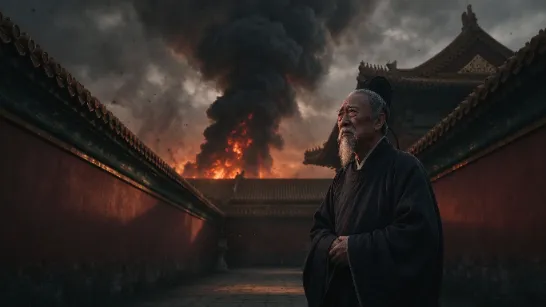
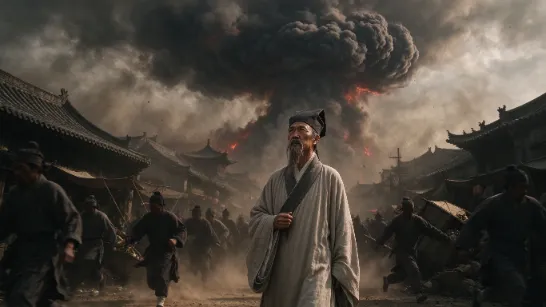
The short film unfolds from the perspectives of three eyewitnesses: Wu Er, a gunpowder craftsman who survived at the blast center; Liu Ruoyu, a eunuch inside the palace; and Xue Gang, a scholar living among the common people. All three accounts come from surviving historical records—meaning there is not a single fictional "protagonist"; every figure is a witness history left behind.
The Scene Most Likely to Expose an AI's Weakness—Reconstructed to Over 95% Fidelity
What do visual-effects spectacles fear most? Getting caught. And an explosion—with smoke, debris, and fire bursting outward all at once—is precisely the kind of complex, fast-moving scene that stresses a model the hardest and is easiest to spot as "fake at a glance."
The team's approach was thoroughly "engineering-driven": they translated literary descriptions from the ancient texts—such as "smoke rising like a black lingzhi mushroom"—phrase by phrase into modern visual concepts like "mushroom cloud"; iterated through roughly four rounds of prompt optimization; and calibrated against real explosion footage.
The result: the Alibaba video-generation model's rendering of the smoke, debris, and other imagery reached over 95% of what the team had expected. On screen, the "black lingzhi" smoke surged upward—and it held, rock solid.
Not "AI Replacing the Director," but a New Division of Labor
What Lu Chuan really wants to explore is not whether AI will replace directors, but how humans and machines can be re-divided.
He began experimenting with AIGC back in 2023—practically a power user—yet this production still "exceeded his expectations." He astutely pointed out a common flaw: general-purpose models are mostly trained on existing costume-drama film and television works, so AI-generated images easily carry a familiar "costume-drama feel," missing the "sense of estrangement" that real history should have.
The Site of History's answer is: humans set the direction, AI handles execution.
- During research and material collection: humans decide the research direction first, and AI assists in gathering materials;
- During production: the director controls the camera direction, visual texture, and overall tone, while AI realizes the intent;
- During thematic reflection: AI can even serve as a "conversation partner," helping to sort out questions.
In one sentence: humans own the sense of problem, core expression, aesthetic judgment, and factual boundaries; AI handles expanding the material, concretizing the imagination, and improving execution efficiency. In the video-generation segment, the Alibaba model's level of involvement and contribution exceeded half of the work, making characters more lifelike and rendering "a thousand faces for a thousand people."
Notably, Lu Chuan himself is participating deeply in creation through programming and model post-training—he sees this as a "two-way choice": realistic characters, complex scenes, and cinematic texture are precisely the strengths of Alibaba's video-generation model. Alibaba, for its part, said it will work with more directors, industry experts, and historians in the future, introducing more rigorous professional information and continuing to strengthen Agentic Video capabilities to raise the intelligence level of the full video-production pipeline.
The Real Signal: AI Video Competition Shifting from "Benchmarks" to "Delivery"
If The Site of History is treated only as a "director plays with AI" news story, you'd miss the more significant shift.
On September 22, at the Apsara Conference's main forum, Alibaba Cloud laid out nearly its entire model portfolio: Qwen3.8-Max beginning to train itself, Qwen3.8-Flash previewing the next-generation architecture, Qwen3.8-Omni unifying omni-modal understanding, and Qwen4 already in training, with parameter scale directly targeting 5–10 trillion; image generation Qwen-Image-3.1, music generation Happy Shrimp 1.1, world model HappyOyster 2.0 Preview, and voice Qwen-Audio-3.1 all made appearances, and the next-generation video model is slated for release in November.
Any one of these models could fill an entire article, but read together with Lu Chuan's short film, the flavor changes—this round of omni-modal upgrades no longer looks like filling in individual capabilities, but more like answering a single question: can models enter real scenarios faster and become genuine productivity?
Over the past year, the AI video race has been about "benchmarks": who tops the blind-test leaderboard, who can generate longer clips. But works like The Site of History pull the competition back to a more down-to-earth dimension—delivery: can you actually finish a film, can you get a top-tier director to put their name on it, can you compress "tens of millions of yuan and months of work" into "five days"?
"AI is not a photographer of existing landscapes, but a creator of unknown ones." Lu Chuan's words might be the footnote for everyone in the industry: the next watershed in image-to-video lies not on the leaderboard, but on the set.