




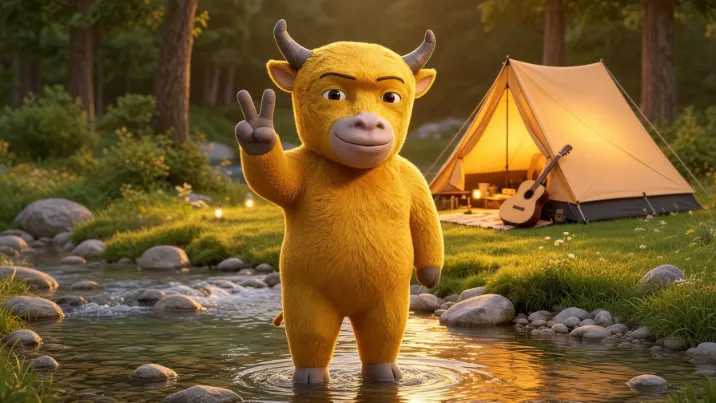
The independently‑produced animation Niu Lai has become a remarkable cultural talking point this year. Created by a mother‑and‑son team without backing from major studios or huge production budgets, this project took five years of passion‑driven work to go from concept to theatrical release. Constrained by the resources of individual creators, its animation fluidity and model detail fall short of industrial‑grade animated productions. Even so, it delivers a fully‑realized narrative core, and this original storytelling is where the work’s true value lies.
The viral success of Niu Lai raises a real‑world question: many creators have fully‑formed stories, characters and worldviews locked in their heads, yet get stuck by prohibitive production barriers. Traditional animation and film production demand assembled teams, specialized hardware and repeated rendering cycles. Extremely high trial‑and‑error costs kill plenty of promising ideas before they can move past the script stage.
Defining Low‑Cost AI Video Production: Low Expense ≠ Low Quality
This brings us to low‑cost AI video production. Low‑cost does not equal low‑quality. Its core value is cutting iteration costs so creative concepts can be visualized rapidly — not patching up finished, flawed footage. Agnes Video 2.5 is a next‑generation video generation model built for exactly this scenario. Capable of 2K output, it delivers commercial‑grade visuals, camera movement and sequence consistency, well‑suited for short drama series, concept shorts and artistic reinterpretations. “Low‑cost” refers to its free Flash tier and affordable API pricing. Creators can test large batches of shots and story concepts without sinking hundreds of thousands into hardware and labor. It does not mean the model produces substandard output.
Real‑World Workflow Cases of Agnes Video 2.5
We can look at several practical reference cases to see how this workflow operates in practice.
Case 1: Generating multiple concept trailers based on the core premise of Niu Lai
Many online creators avoid altering the original film. Instead, they extract its central theme: a young calf gains inner courage through dream‑based trials, and use Agnes Video 2.5 to generate concept clips with distinct artistic directions.
One variant leans into free‑form Chinese ink‑wash aesthetics, retaining core plot elements such as the calf, grasslands, parched pastures and wolf packs. It produces short clips testing atmospheric wide shots of grasslands and twilight dreamscapes. A second variant adopts a grounded documentary‑inspired style, toning down fantasy elements and emphasizing the hardships of survival on the grasslands.
Under traditional workflows, producing these two stylistic versions would require modelling, material setup and key‑frame animation over weeks. With the model, creators tweak prompts while preserving core character assets to generate diverse shots quickly. These outputs serve for pre‑production style validation, not as quality fixes for the original film.
Case 2: Student‑led independent short‑film production to reduce iteration overhead
A student creative team developed an animal‑growth short sharing thematic similarities with Niu Lai, following a vulnerable creature overcoming hardship to achieve inner growth. Limited student budgets ruled out hiring a full animation crew.
Their workflow leveraged Agnes Video 2.5. They used the free Flash tier to test camera work, lighting and character performances at scale. Once parameters were validated, they switched to the standard mode for high‑fidelity exports.
Reusable character and scene assets preserved visual consistency across cuts. Final assembly was completed via manual editing. Most human effort went into scriptwriting and storyboarding rather than tedious manual key‑framing. The finished multi‑minute short was completed at a fraction of traditional animation costs, with visuals meeting commercial standards rather than compromised amateur quality.
Case 3: Rapid shot iteration for commercial short‑form drama
Multiple AI short‑drama teams adopt Agnes Video 2.5. For example, on the fantasy short The Last Lantern, the team saved assets for the lantern keeper, bronze lantern and city environments. They split the narrative into story beats and mass‑generated sequential shots, iterating multiple storyboard versions to select the most compelling takes for further refinement. Here, the model enables fast creative visualization for prototyping; final deliverables are suitable for commercial release. Low cost applies to experimentation, not degradation of final picture quality.
What Niu Lai Teaches Us About AI‑Assisted Creation
Returning to what Niu Lai teaches us: tools exist not to cover up creative shortcomings, but to unlock new avenues for ideas.
Well‑funded professional teams can polish visuals at will. Independent creators operate with limited budgets, where ideas are their most precious resource. Agnes Video 2.5 bridges the gap between imagination and realized footage. Freed from exorbitant iteration costs, creators can boldly test diverse camera setups and art styles, turning mental narratives into video prototypes.
Closing Thought: AI as a Catalyst for Original Storytelling
Niu Lai proves sincere stories can resonate with audiences even under resource constraints. AI‑video tools represented by Agnes Video 2.5 open new doors for storytellers. It is not a band‑aid for poor‑quality works, but a production tool lowering barriers for original concepts.
Storytelling power ultimately defines audience impact. AI simply lowers the cost of bringing those stories to life. The two complement each other — this is the true meaning of low‑cost AI‑driven video creation.






'%20fill-opacity='.4'/%3e%3cpath%20d='M29.07%2012c.982%200%201.473%200%201.88.194.35.166.667.457.863.79.23.389.27.859.354%201.797.27%203.072.518%207.922-.297%2010.472-1.03%203.22-5.8%206.507-8.257%208.023-.477.295-.715.441-1.038.515a2.227%202.227%200%200%201-.868.006c-.324-.07-.565-.215-1.046-.504-2.512-1.51-7.435-4.811-8.478-8.04-.888-2.752-.622-7.52-.327-10.524.09-.914.135-1.372.365-1.757.196-.327.516-.617.86-.78.407-.193.89-.192%201.853-.192H29.07z'%20fill='var(--fill-0,%20%23FD7F11)'/%3e%3cpath%20d='M26.337%2017.75a.854.854%200%200%201%201.212-.11.872.872%200%200%201%20.11%201.218l-6.088%207.392a.855.855%200%200%201-1.2.122l-.07-.063-3.906-3.944a.871.871%200%200%201%200-1.222.853.853%200%200%201%201.216%200l3.24%203.268%205.486-6.66z'%20fill='var(--fill-0,%20white)'/%3e%3c/svg%3e)