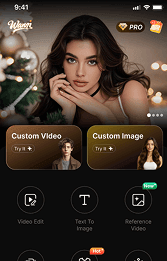




For a long time, the AI video generation track has been constrained by industry bottlenecks: "short durations, low controllability, and difficulties in commercialization." However, with the advent of the new-generation advanced video generation model, Wan 3.0, this industry stalemate is finally reaching a breakthrough point.
The leap in foundational large models has rapidly triggered follow-ups and strategic positioning among application-layer platforms. Currently, multiple mainstream creative platforms, including SeaArt, Pollo AI, and Higgsfield, have initiated varying degrees of official teasers, API integrations, and scenario-based adaptations centered around Wan 3.0's 30-second long video, multi-modal reference, and fine-grained editing capabilities.
Technological Breakthrough: Wan 3.0 Reshapes Commercial Content Standards
The underlying logic for platforms rushing to follow suit is that Wan 3.0 fundamentally solves the accuracy and usability pain points of AI video creation, providing a technical cornerstone for true commercial implementation:
- Breaking Physical Laws to Ensure Long-Take Usability: Traditional AI-generated long videos commonly suffer from "hallucinations," such as visual collapse in the latter half of the frames or character misalignment. Wan 3.0 strictly guarantees action continuity and scene physical logic across a full 30-second span, establishing a new industry benchmark for visual quality.
- Multi-Modal Reference for Precise Creative Replication: It completely breaks the limitations of single text prompts. It supports the import of reference images, storyboard sketches, and structured documents, highly aligning with the professional workflows of various creators.
- Frame-Level Precision Editing to Discard "Blind Box" Generation: It changes the inefficient mode of "remaking everything for a single error" seen in traditional models. The capabilities for localized inpainting and custom style conversion endow AI videos with the commercial operational space for post-production editing and modification for the first time.
Platform Dynamics: Integration Progress and Strategic Focus of Three Representative Tools
In this wave of integrations, platforms with different market positioning have demonstrated clear dynamic paces and differentiated integration paths:
1. SeaArt: High-Profile Official Teaser, Concurrent Internal Testing and Workflow Adaptation
As a representative of comprehensive creative platforms, SeaArt has shown the most agility in its integration pace.
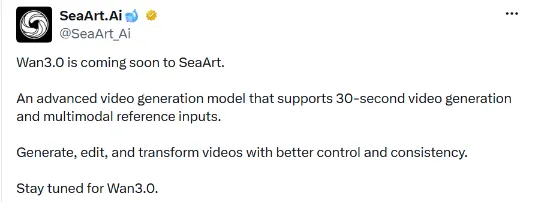
✅️Latest Dynamics: SeaArt's official social media account (@SeaArt_Ai) has officially tweeted: "Wan3.0 is coming soon to SeaArt." According to insiders, the platform's technical team has completed the core API docking and is currently focusing on overcoming the timeout retry mechanisms for long video task queues, frontend multi-document interactive panel adaptation, and point billing logic.
✅️Empowerment & Implementation: The platform has launched small-scale beta testing for selected premium subscribers, aiming to bridge the closed loop of "text/document planning - asset import - 30-second HD finished product," providing a one-stop comprehensive production solution for mass everyday users and small-to-medium enterprises.
2. Pollo AI: Responding to High Community Demand, Prepping for High-Efficiency Production Pipelines
Headquartered in Singapore, the lightweight aggregation platform Pollo AI is renowned for its ultra-fast rendering and "out-of-the-box" high-definition export experience.
✅️Latest Dynamics: Facing soaring demands for Wan 3.0 from the creator community, the Pollo AI team has placed the evaluation of the model's integration on their core agenda. They are currently preparing to bind Wan 3.0's native high quality (1080P) at the pipeline level with the platform's existing "video denoise" and "4K upscaling" tools.
✅️Empowerment & Implementation: Accurately targeting cross-border social media and TikTok/Shorts short-video matrix operation teams. Through standardized, high-efficiency rendering processes, it shortens the delivery cycle of long-video commercial content, achieving cost reduction and efficiency enhancement.
3. Higgsfield: Doubling Down on Cinematic Control, Tackling Character and Camera Movement Compatibility
Focusing on professional film and 3D creators, Higgsfield emphasizes Wan 3.0's breakthroughs in "visual controllability" and "content consistency."
✅️Latest Dynamics: The Higgsfield development team is currently going all out to advance the algorithmic compatibility and parameter tuning between Wan 3.0 and their underlying deep camera movement control system (Cinema Studio) and character consistency system (Soul ID).
✅️Empowerment & Implementation: Aimed at solving the industry's long-standing pain points of "AI character face-changing" and "disconnected camera transitions." This combination will significantly lower the technical threshold for shooting 30-second continuous footage of virtual IPs, precisely penetrating the cinematic pre-visualization, feature-length animation, and high-end brand commercial tracks.
Industry Outlook: A Comprehensive Reshuffle from 0-to-1 to 1-to-10
Looking across this technological iteration, the AI video track has completely finished the "0 to 1 breakthrough in generation capability" and has officially entered the "1 to 10 commercial implementation competition."
With SeaArt's official teaser and the follow-up preparations of platforms like Pollo AI and Higgsfield, the foundational capabilities of underlying large models are rapidly settling into the industry's "infrastructure." In the coming months, the entire industry's competitive focus will completely shift to four core dimensions: computing cost control, deep workflow adaptation, scenario-based feature polishing, and the user commercialization closed loop. Platforms that can take the lead in relying on Wan 3.0 to complete scenario-based implementation and truly empower the commercial value of creators will inevitably reshape the market dominance of next-generation AI content creation.





'%20fill-opacity='.4'/%3e%3cpath%20d='M29.07%2012c.982%200%201.473%200%201.88.194.35.166.667.457.863.79.23.389.27.859.354%201.797.27%203.072.518%207.922-.297%2010.472-1.03%203.22-5.8%206.507-8.257%208.023-.477.295-.715.441-1.038.515a2.227%202.227%200%200%201-.868.006c-.324-.07-.565-.215-1.046-.504-2.512-1.51-7.435-4.811-8.478-8.04-.888-2.752-.622-7.52-.327-10.524.09-.914.135-1.372.365-1.757.196-.327.516-.617.86-.78.407-.193.89-.192%201.853-.192H29.07z'%20fill='var(--fill-0,%20%23FD7F11)'/%3e%3cpath%20d='M26.337%2017.75a.854.854%200%200%201%201.212-.11.872.872%200%200%201%20.11%201.218l-6.088%207.392a.855.855%200%200%201-1.2.122l-.07-.063-3.906-3.944a.871.871%200%200%201%200-1.222.853.853%200%200%201%201.216%200l3.24%203.268%205.486-6.66z'%20fill='var(--fill-0,%20white)'/%3e%3c/svg%3e)