




Most games begin with a simple idea.A developer imagines a world:"Create a survival adventure on an abandoned alien planet."The idea is easy to describe. Turning it into a playable experience is much harder.A complete game requires many connected systems: world design, gameplay mechanics, characters, environments, assets, interactions, and testing. Even a small prototype usually requires different skills across programming, design, art production, and technical integration.The biggest challenge in game development is often not generating individual elements. It is transforming a creative concept into a consistent interactive system.This is where an AI Game Generator introduces a new possibility.
This is a video introduction about the Kimi K3. You can click the link to learn more about it.
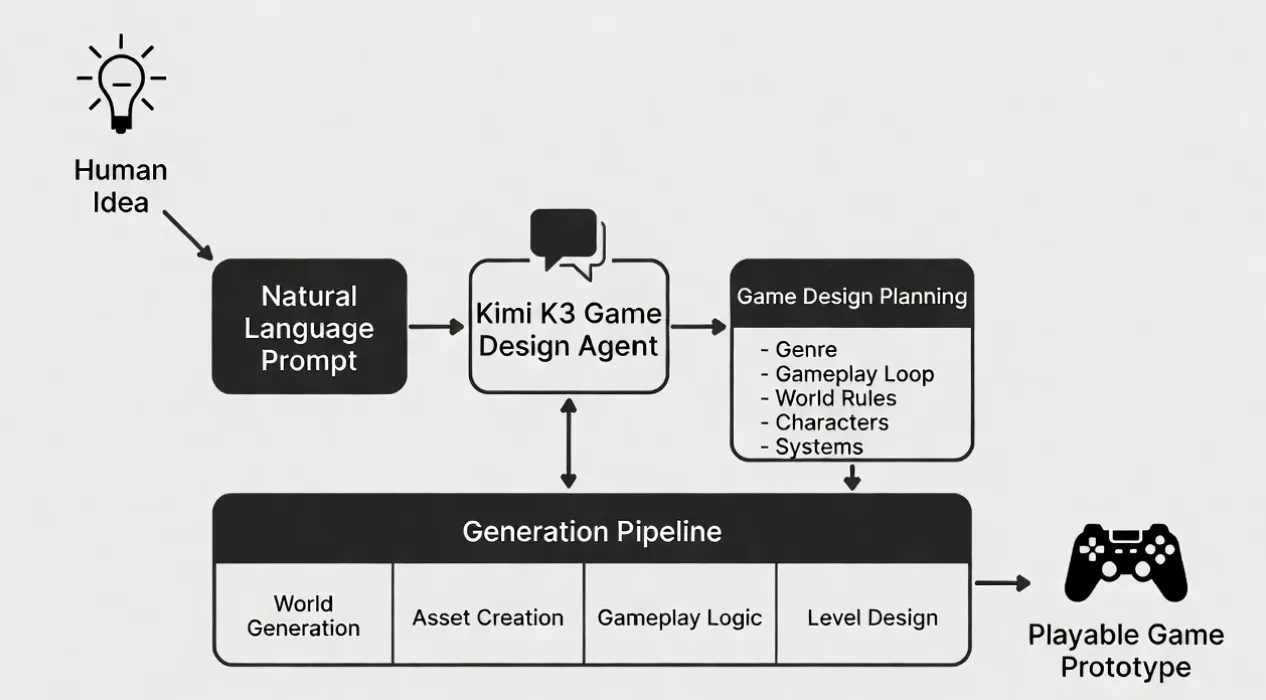
Instead of manually translating an idea into dozens of technical tasks, developers can describe the experience they want to create. An AI system can then analyze the concept, generate a structured development plan, and coordinate different tools to build a playable prototype.In this workflow, Kimi K3 can act as the intelligence layer that transforms high-level game ideas into structured generation processes.Rather than replacing game engines or developers, the model works as a bridge between human creativity and game creation systems.
The Real Challenge: Generating a Game, Not Just Generating Content
Modern AI systems can already generate many types of content.They can create images, write code, generate 3D assets, and produce dialogue.However, a game is not simply a collection of generated components.A playable game requires those components to work together.
For example, generating a fantasy village is relatively straightforward. A system can create buildings, landscapes, and characters.But creating a functional fantasy village requires deeper understanding:
Where should the player go?
What role do NPCs serve?
What gameplay opportunities exist?
How does the environment support the player's goals?
The difference is the connection between content and experience.An AI Game Generator must understand game structure, not only generate game elements.
A successful system needs to reason about:
- the type of game being created,
- the player's expected experience,
- the relationship between gameplay systems,
- the sequence of steps required to build the prototype.
This makes AI game generation fundamentally different from traditional content generation.
Kimi K3 as a Game Design Agent
A powerful AI Game Generator requires more than a model that can produce individual outputs. It needs an intelligent system that can understand creative goals, make design decisions, and maintain consistency across different parts of a game.This is where Kimi K3 can serve as a Game Design Agent within the generation process.Rather than directly generating every asset or writing every piece of code, Kimi K3 focuses on understanding the intent behind a game concept and translating it into a structured design direction.
A natural language game idea often contains multiple layers of information, including the intended player experience, gameplay mechanics, world structure, and technical requirements. The challenge is not simply identifying these elements, but understanding the relationships between them.A survival game requires more than an environment. The world needs resource systems that support exploration, mechanics that create progression, and interactions that give players meaningful decisions.Kimi K3 helps maintain the connection between creative intent and technical implementation, allowing generated components to follow a consistent gameplay vision.
This is why AI game generation is fundamentally a coordination problem. Creating individual elements is only the first step. The more difficult task is ensuring that environments, systems, and interactions work together as a unified experience.
The Architecture Behind an AI Game Generator
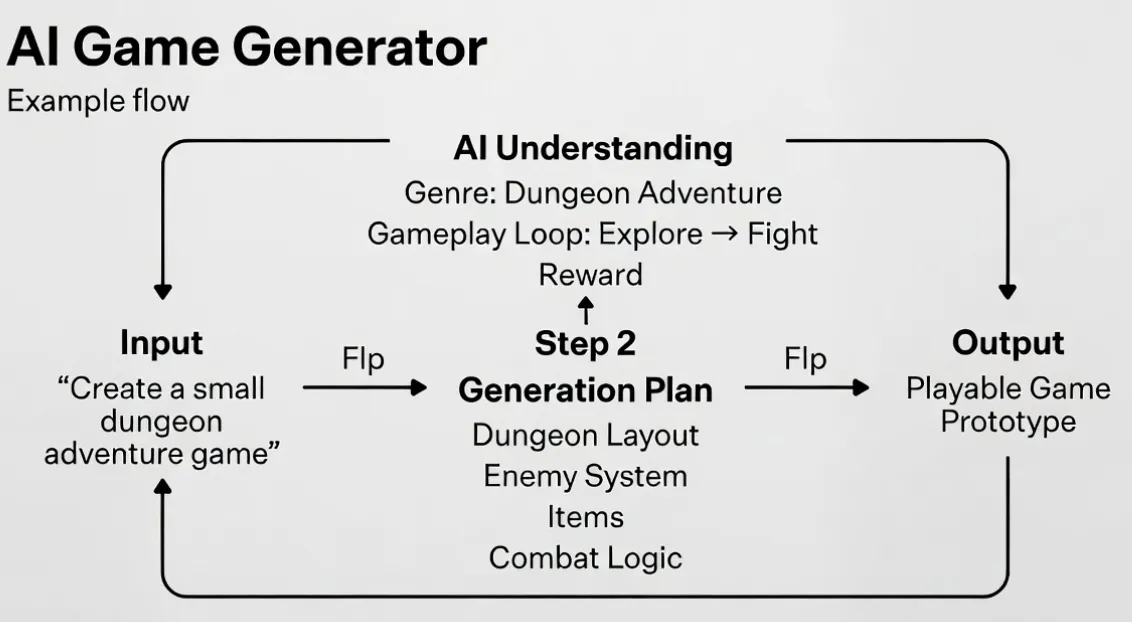
Generating a game is fundamentally different from generating individual assets or code fragments. A playable experience requires multiple systems to work together under a consistent design direction.An AI Game Generator needs to understand more than the visual or technical requirements of a project. It needs to interpret the creative intent behind a game idea and maintain the relationships between world structure, gameplay mechanics, player interactions, and generated content.
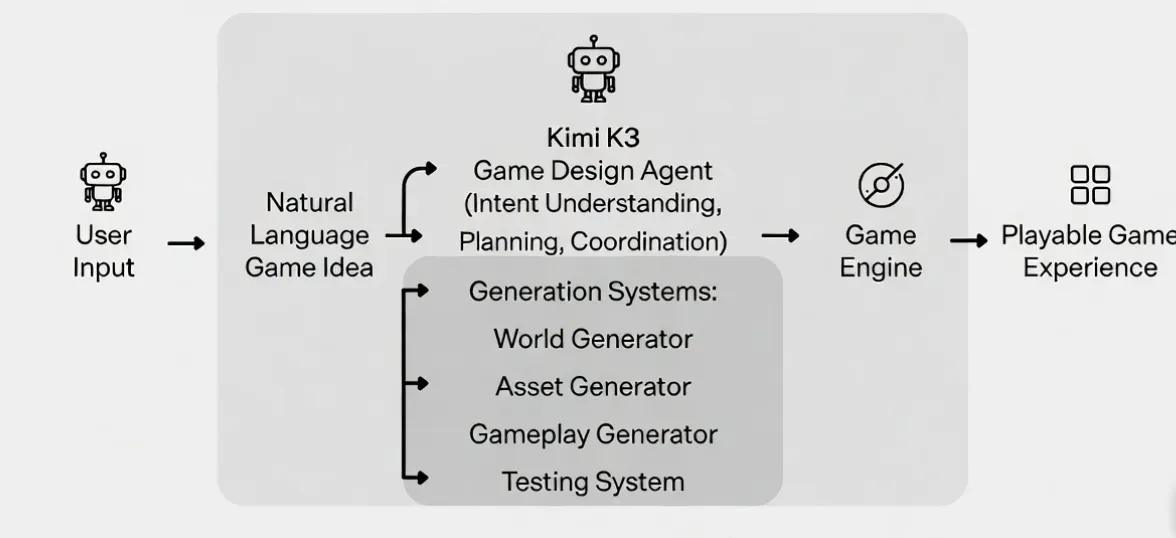
At the center of this architecture, Kimi K3 serves as the intelligence layer that connects creative concepts with game development systems. Instead of directly replacing the game engine, it provides the reasoning capability required to organize complex generation tasks and maintain consistency throughout the creation process.The generation system can integrate different capabilities, including world construction, asset creation, gameplay logic, and engine-level operations. However, the value does not come from these individual components alone.
The key challenge is coordination. A game generator must ensure that generated elements support the same gameplay vision rather than becoming disconnected pieces of content.This is where an advanced reasoning model becomes important. By understanding context and design goals, Kimi K3 can help transform a simple idea into a structured game system where environments, mechanics, and interactions work together.
Technical Challenges of AI Game Generation
Although AI Game Generators are promising, several challenges remain.These challenges show that AI game generation is not simply about producing more content.It is about creating systems that understand how different elements combine into meaningful experiences.
- The first challenge is maintaining consistency.A game contains many connected systems. Characters, environments, mechanics, and progression must follow a consistent design direction.
- The second challenge is gameplay quality.A technically complete prototype does not automatically become an enjoyable game. AI systems need a better understanding of player motivation, pacing, difficulty, and interaction.
- The third challenge is human control.Creative tools require flexibility. Developers need the ability to guide the generation process, review decisions, and refine the final result.
Conclusion: A New Path from Ideas to Interactive Worlds
The future of AI Game Generators is not about removing developers from game creation.Instead, it represents a shift in how people interact with development tools.Developers may spend less time translating ideas into technical operations and more time defining the experiences they want to create.With Kimi K3 acting as a reasoning and planning agent, AI Game Generators could become a bridge between creative concepts and playable prototypes.The biggest change is not that AI can generate more game assets. The real transformation is that a simple idea may become the starting point of a structured process that leads to an interactive world.



'%20fill-opacity='.4'/%3e%3cpath%20d='M29.07%2012c.982%200%201.473%200%201.88.194.35.166.667.457.863.79.23.389.27.859.354%201.797.27%203.072.518%207.922-.297%2010.472-1.03%203.22-5.8%206.507-8.257%208.023-.477.295-.715.441-1.038.515a2.227%202.227%200%200%201-.868.006c-.324-.07-.565-.215-1.046-.504-2.512-1.51-7.435-4.811-8.478-8.04-.888-2.752-.622-7.52-.327-10.524.09-.914.135-1.372.365-1.757.196-.327.516-.617.86-.78.407-.193.89-.192%201.853-.192H29.07z'%20fill='var(--fill-0,%20%23FD7F11)'/%3e%3cpath%20d='M26.337%2017.75a.854.854%200%200%201%201.212-.11.872.872%200%200%201%20.11%201.218l-6.088%207.392a.855.855%200%200%201-1.2.122l-.07-.063-3.906-3.944a.871.871%200%200%201%200-1.222.853.853%200%200%201%201.216%200l3.24%203.268%205.486-6.66z'%20fill='var(--fill-0,%20white)'/%3e%3c/svg%3e)